Introduction
Brain Tricks is a casual puzzle app that challenges players with mind-bending riddles and quirky scenarios designed to train logic, memory and creative thinking. In Brain Tricks you'll encounter levels where the obvious answer often fails, so the game rewards close observation, lateral thinking and interactive gestures like tapping and swiping. The experience blends short brain workouts with longer, layered puzzles so you can pick up a quick challenge or settle in for a more thoughtful session.
Key Features
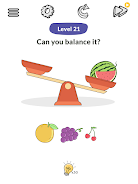
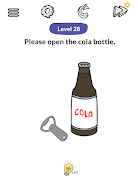
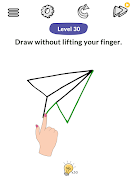
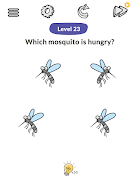
The game delivers a wide variety of brain teasers that test reasoning, pattern recognition and memory in different ways. Rather than relying on repetition, levels introduce counterintuitive solutions and small visual cues that require you to look beyond the obvious. Interactive scenes respond to tap, drag and multi-step gestures, and playful animations reveal hidden elements when you experiment with the environment. Progression is steady: early puzzles teach the rules and later stages combine mechanics to create richer problems.
Brain Tricks also emphasizes concise level design—each puzzle is built around a single twist or mechanic so you can quickly understand the objective and explore possibilities. Occasional surprises encourage replay, and subtle differences between similar scenes reward careful observation rather than brute force guessing.
Gameplay and Controls
Controls are intentionally simple to keep the focus on thinking rather than complicated inputs. Most interactions use tapping and swiping to move objects, reveal clues or trigger animations. Some puzzles ask you to rearrange visual elements or time a gesture correctly; others require a sequence of taps to uncover a solution. The tactile, trial-and-error nature of these controls makes experimentation satisfying and reduces reliance on memorizing button combos.
Progression and Challenge Systems
Levels are grouped into themed stages that gradually increase in complexity. Early stages introduce one mechanic at a time and later puzzles combine these mechanics into multi-layered challenges. Difficulty ramps up in a predictable way so players can see steady improvement, and many levels are intentionally designed to be solved in several different ways depending on how you interpret the clues. If you prefer to revisit a puzzle, the structure supports replaying levels to discover alternate endings or hidden solutions.
Visual Style and Customization
The visual presentation mixes clean UI elements with quirky animations to keep the interface approachable while adding personality to each puzzle. Scenes use high-contrast, readable graphics so clues are visible without distracting from gameplay. Settings allow you to toggle sounds and animations if you prefer a quieter or faster-paced experience; these modest customization options help tailor the game to your device and play style.
Replay Value and User Experience
Replay value comes from puzzles that contain multiple layers and non-obvious solutions, plus the satisfaction of spotting details you missed before. The pacing avoids grind by keeping session lengths flexible: short puzzles for quick play and longer, puzzle chains for deeper focus. The interface aims to be intuitive for new players while offering enough depth to engage more experienced puzzlers who enjoy lateral thinking.
Accessibility and Performance
Brain Tricks prioritizes clarity and ease of interaction: controls are big enough for comfortable tapping, text is kept concise, and the overall layout reduces accidental inputs. The game runs smoothly on a wide range of devices and is optimized to keep animations responsive without draining battery unnecessarily. These choices make the app suitable for casual play on phones and tablets alike.
Offline Play and Practical Details
Most puzzles can be played offline, allowing you to train logic and memory without a persistent internet connection. Files are compact and the app is designed to resume quickly when you return to a paused session. Regular small updates improve stability and add new puzzle packs without changing the core single-player experience.
Advantages
Brain Tricks sharpens problem-solving through varied, well-paced challenges and intuitive touch controls. The gradual difficulty curve and visual puzzle design make it accessible to a broad audience, while the design leaves room for clever, non-obvious solutions that reward careful observation.
Disadvantages
Some solutions depend on lateral thinking and may feel counterintuitive or occasionally frustrating if you expect strictly logical answers. Later levels increase in complexity and can demand more attention, so players looking only for fast-paced action may prefer a different style of game. Overall, Brain Tricks is best suited to people who enjoy experimenting and thinking beyond the obvious.
- No virus
- No advertising
- User protection
Information
- File size: 76.40 M
- Language: English
- Latest Version: 1.0.99
- Requirements: Android
- Votes: 135
- Package ID: puzzle.brain.games.brain.test.brain.out
- Developer: Puzzle Go
Screenshots













Explore More
Small games that help pass the time have evolved into a plethora of cool and refreshing experiences that allow us to briefly immerse ourselves without getting addicted, providing us with plenty of enjoyment even if we can only play them for a short while sometimes.

TV Simulator 2

Battle of Predictions

Defence Tower:Idle TD Strategy

Lord of Puzzles

Open World Bike Drive Game 3D

OFC Poker & Blackjack 21

pk365

Mineheart Abyss






















![야, 맞춰봐] 롤-퀴즈 (리그오브레전드 스무고개, 스피 APK](https://image.gamespot.com.cn/upload/202607/08/9a2d1vwm410QjE2.jpg)